
I am certain some of what will be stated in this blog I would have already mentioned to some extent in previous blogs; either way, I think it prudent to those of us who are on this parenting/mothering/fostering/child-rearing journey to hear the experiences of those of us who are still learning as we go along, wherever we are on the journey.
So, I recently had a very open discussion with my offspring about how trauma can be manifested in the parenting process. As I listened to her articulate her experiences in how she has been parented, it dawned on me that some of what was given to her (in the overall parenting of her) is not what was always required by her – there are things that were lacking in her “growth experience”.
Now if you ask any person who knows me, observes me, interacts with me, etc. they will tell you, beyond doubt, that I offer all of myself to my child. I give of my resources, and I make myself available, so that she has all that she needs and wants. While she has agreed that I am one of the most reliable persons that she knows, she has also asserted that there are elements of my parenting that might be lacking. For her, I am not always “emotionally reliable”, despite being available to her beck and call.
WOW! What a punch-to-the-gut wakeup call that was. That was hard to hear, as I felt that I have emotionally made myself available to her; after all, she could reach me any time, and I would come running and she could talk to me about anything (or so I believed). From the perspective, I am sure that we could all agree that none of us is any one thing all the time, especially with parenting.
But what good would it do to argue absolutes, right?!
Time for introspection, which is always needed in relationships, especially those with our children. Situations are not always hunky-dory, and as parents, we do not always have control over other variables in the parenting process, but as mothers, especially, we tend to take on the entire responsibility, even when some of those responsibilities lie elsewhere.
In this much needed tête-à-tête, she further stated that while I am there for her, there are things in this entire process, all sides included, that have not necessarily been good to her and for her. While I was aware of some of what was problematic, I didn’t necessarily realize the extent to which these “things” truly affected her, nor did I realize the ways in which my response to those things bothered her.
In going forward, it is therefore important for me to take responsibility for my part and to truly reflect on how those things have created some type of trauma for her and to also continue to provide the necessary interventions to help her to heal so that she can properly navigate the world outside of the parenting process. I have had many conversations with other parents who do not always get the opportunity to know about those things that truly trouble their children or they either find out when those children are full blown adults when wounds would have completely festered. I have also had conversations with parents who have had similar situations, where they were forced to introspect at very critical points in the parenting process. As hard of a conversation it was to have had, I am thankful that I was given the opportunity to process my role, from her perspective.
A part of myself wants to blame myself, but then I reflect on one of my recent blogs about operating in ones best… So I let go, and let God!
As I ponder further on our conversation, the following came to mind:
What (some) parents do not realize
- Our children’s trauma may not look like ours for them to be considered trauma.
- Though our children may acknowledge and applaud what they deem to be our parenting strength in some areas, it doesn’t mean that they are not lacking and needing from us in other key areas.
- Our children do not care what anyone on the “outside” thinks we are doing, if they remain unfulfilled in an area(s) that they believe is key to their development at any given point.
- Parenting is not about the validation of the world; it is about what we ACTUALLY do or NOT do in the process of parenting them.
- What our children require do not remain constant in all areas; therefore, we must pay attention.
- The fact that you may believe that you do not have trauma in your own life, doesn’t mean that you won’t or can’t or have not inflicted trauma unto your child.
- The behaviour/lifestyle of a parent can cause trauma on a child or affect their view on life. They see AND internalize more than we realize.
- It is wise and prudent to accept responsibility (and let them know) for the role you have played in a child’s trauma.
- Observed reckless behaviours can be trauma-contributors.
- Our children’s needs change as they evolve. They may not always say what those needs are, so sometimes we misread.
- Sometimes the choices that we have made for what we deem to be the good of them turns out to be at their detriment.
- Once we recognize our parenting ills, we have to try our best to fix ourselves or at the very least help them to navigate so that they can heal, which often requires help outside of what we don’t know (professional help, ie).
- Getting your child professional help doesn’t always mean that you are a parenting failure
- Good parents make parenting blunders too; no parent is a perfect parent.
What children do not yet know
- Good parents make parenting blunders too; no parent is a perfect parent (this is true for both parent and child).
- Parents are human beings with issues, baggage and traumas of their own. We become sad, defeated and broken at times; We get tired too. It is easier for us to fix physical tiredness than it is for us to fix emotional fatigue. Sometimes it doesn’t matter how many degrees we have, we are clueless what to do with our emotional fatigue.
- Though they may see us as “strong”, we are not always strong in all areas of our lives as it may appear to them.
- We collect our parenting tools as we go along, depending on what is needed at any given time.
- Sometimes we do not know that we do not possess the RIGHT tools until we are told.
- Some parents do not tell nor do they realize that they have traumas, but they are often manifested in some reckless behaviours.
- Parenting is probably the only thing in our lives that requires for us to be there even when we can’t; we cannot apply for departmental, sick or vacation leave from parenting. We just must, because even when they are not with us, we are parenting nonstop, in our minds.
- Some of the things that they become angry at us for today, they will say “thank you” for later in life.
- They (our children) won’t quite understand why parents do what we do until they understand (whenever that is); this simply means that their appreciation (of us) or the lack thereof won’t manifest until it does (often into their adult lives).
- The more exposed they become to the world, is the more their views of who we are as parents and what we have done will change (good or bad).
The bottom line is that parenting is as complex as being a child is. Our children see, process, and internalize at every phase in their lives.
So what do we do about this very complex matter of parenting despite ourselves (what we bring to the table or don’t bring?)
I do not quite have the answer to that question, to be honest. I am still learning.
What I can say is that we have to be very open about wanting to be better parents (that sometimes means fixing ourselves) at every stage of the parenting process. Listening to our children helps at every stage of parenting them. It is true that what they require is not always what we give, but what they require is sometimes not known to even them.
While some of us have exposed our children to some things that they shouldn’t have been exposed to by virtue of what we have accepted or have done in our own lives, the pandemic has brought with it another set of parenting challenges. Some parents are operating on E (nothing left), when the truth is our children, at this time, require the most of us, as they themselves are operating on their own versions of being empty (E). Accordingly, we have to be willing to, at the very least, try to help them heal from what they are experiencing and have experienced that might be traumatic to them.
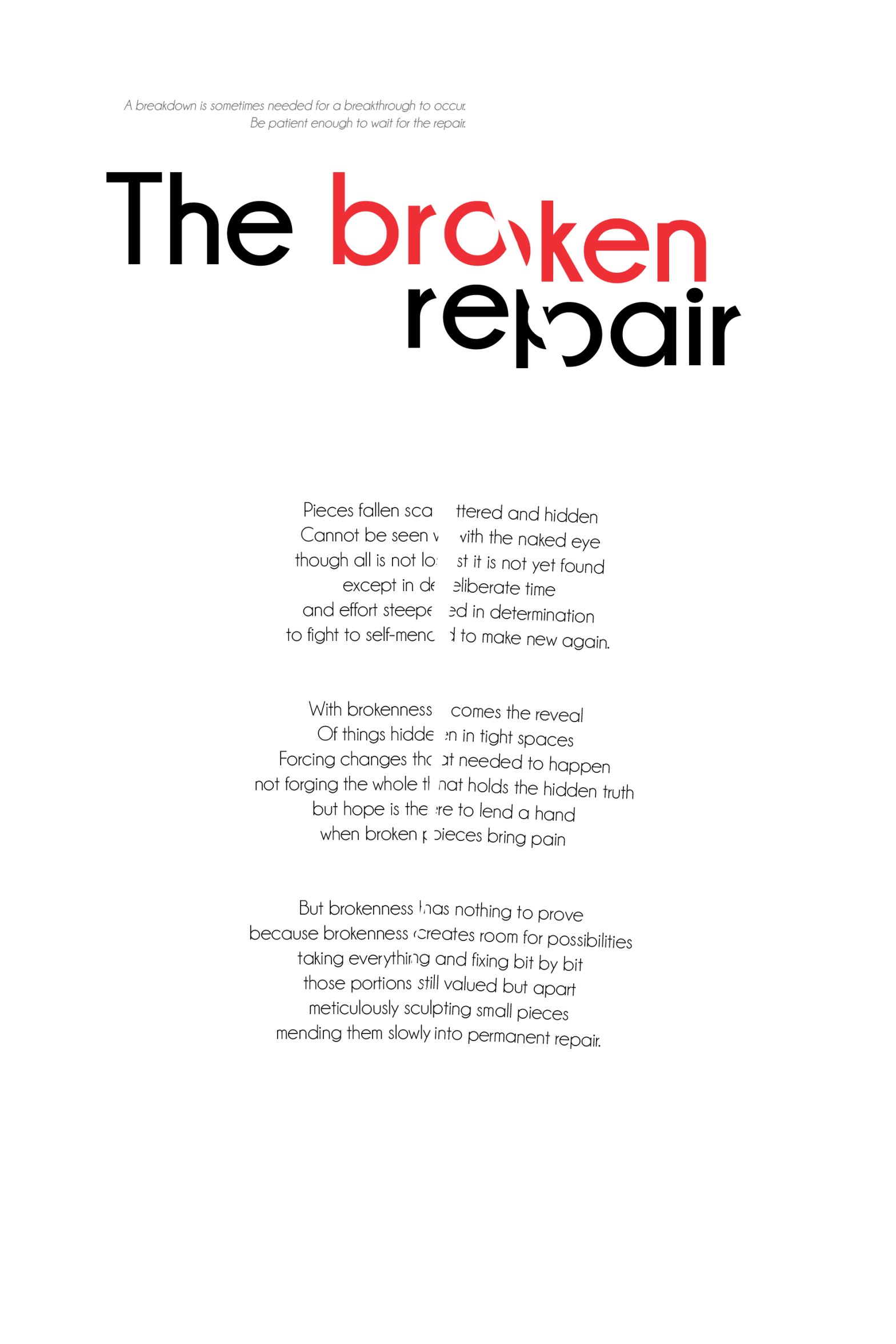
After all, there is value to be found in the “Broken Repair” (check out image at the top of the blog, which is one of my poems from my recently launched book, “The Chronicles of a Woman: The Truth-teller”, now available on http://www.amazon.com.

 PARENTING, ADVOCACY AND EVERYTHING IN BETWEEN
LOVE THE HONESTY OF THE ARTICLE .HONEST CONVERSATIONS ARE IMPORTANT FOR GROWTH . AS YOU SAID, WE ARE ASKED TO GIVE OF OUR BEST, WE WON’T ALWAYS GET IT RIGHT.
AS PARENTS AND INFLUENCERS ATTEND TO OUR CHARGES WE THEREFORE HAVE TO ALWAYS PROVIDE THE PLATFORM TO LISTEN AND COMMUNICATE.
TRUE THE CHILDREN WILL GET IT EVENTUALLY ( WE HOPE) AS THEY ARE VACILATING TRYING TO UNDERSTAND THEMSELVES AS THEY ARE ON THE JOURNEY OF BECOMING..
TRAUMA IS PERSONAL.