
I am driving along minding my business and singing along to the sweet sounds of 90s R&B, when suddenly I heard it.
Klunk ku klunk ku klunk.
Dah heck?!!
Why do I feel as if I am on the bumpiest road ever? Except, I am not! Immediately, I can tell this is not normal. Although I am moving, things were not normal.
This doesn’t feel right, I thought. Maybe the shocks need to be changed, I surmised. I am not mechanic nor do I truly understand the inner workings of a motor vehicle, but I have just about enough knowledge to know when something is wrong with my car.
After another day of making this observation, I called my mechanic, who took the vehicle to have it properly checked and let me know that the “links” needed to be changed. On his first assessment, he also let me know that I would have been able to drive for a few more days, etc., but I was not comfortable. The sound made me nervous, so I had to get it repaired with immediate effect, despite the unplanned financial sacrifice it would take.
In a jiffy, my car is repaired by one of the most reliable mechanics I know, who ensured that all was well in my car-driving world, and I was back on the streets again!
See what I did there? I recognized immediately that there was an issue with potential disaster looming. Right away, I did as the problem instructed. I knew it was time to call a mechanic, because this was an issue I couldn’t have solved on my own. I didn’t have the right tools nor proper know-how regardless of my ability to read and understand. With his years of service and expertise, I was sure he would have been able to fix the issue, or refer me to someone more capable, at the very least; I trusted that. Plus, it would not have served me and the things I must accomplish in my day to day had my car been further damaged, because of my lack of proper intervention.
As I move forward with this piece, please keep in mind the concept of “proper intervention”.
I say all this (and this was a true story) to bring to the fore an issue that continues to plague human beings, especially in this time – our MENTAL HEALTH. I have witnessed well-thinking, educated, good-intentioned human beings who know deep down that something wasn’t right with their mental space do nothing or hardly anything to get proper intervention to resolve the matter; admittedly, I am guilty of that. We hear, in our personal lives, our own version of the “klunk ku klunk” sound that my car made; so many of us are walking around with issues in our lives/mind, etc. that we know we cannot resolve on our own; yet, we do nothing about it.
We are quicker to fix those things that are clearly seen, but never our mind space – not until it is too late, for many of us. I think I have discussed mental health more than any other topic in the past four months. But there is a reason for that… all you have to do is to pay attention and you can’t help but see/hear, etc. what is happening globally in our current climate.
It is being reported that mental health continues to worsen, and many countries are ill-prepared to handle the crisis. With this, we can all agree that mental health is not just the “hot topic,” nor is it to be considered buzz words; it is a necessary topic that has become even more discussed and addressed now than it has ever been. But it has to be more than just a topic of discussion, we have to change the narrative in terms of how, when and where we enter into these discussions about caring for your mental state with “proper interventions”.
So what then is mental health?
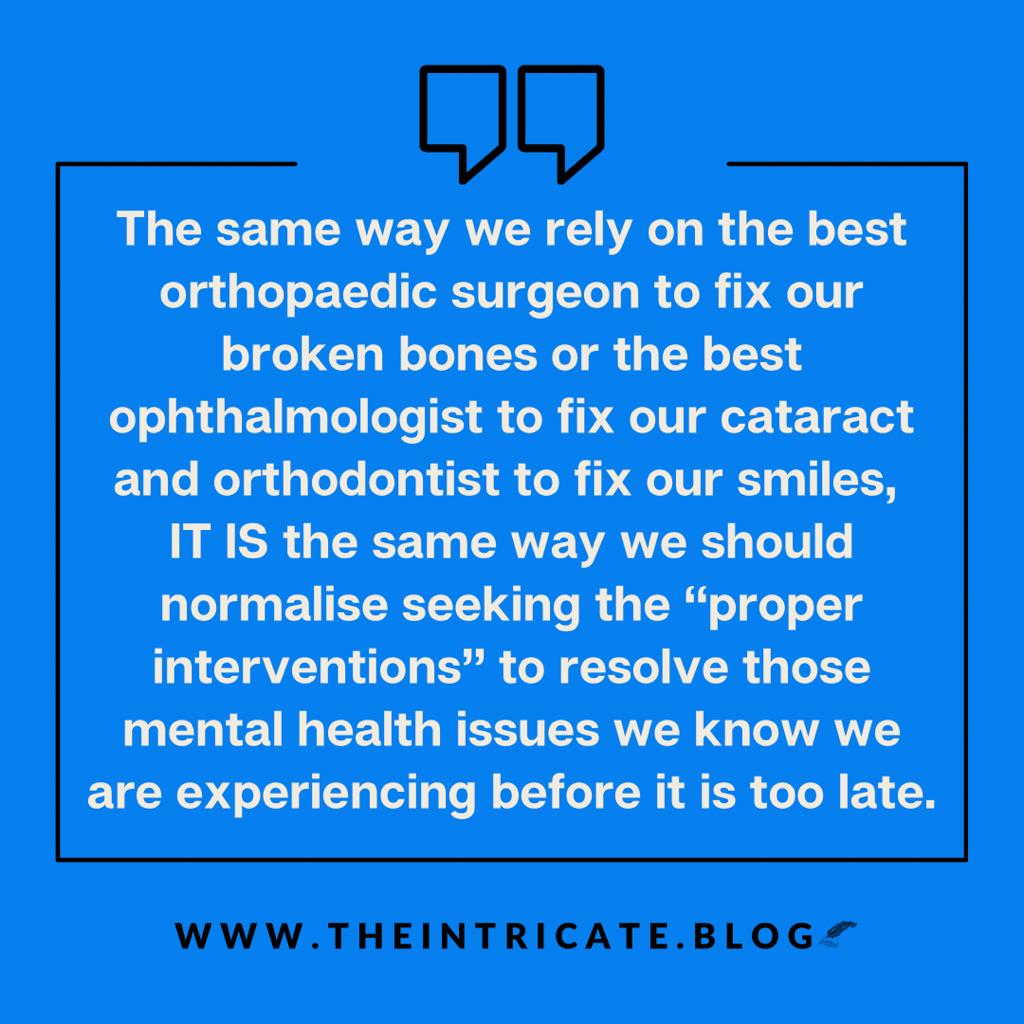
There are many different types of mental illnesses, also called mental disorders, that range from depression to schizophrenia to eating disorders, and these have many different presentations. While this is definitely not my forte, I will not be discussing how these manifests. However, I am aware that many times we won’t truly know our diagnosis, if we do not seek proper interventions. But how many of us actually do that? Unfortunately, we have been taught to minimize that which cannot be touched and to self-fix, so we do not run to get the help we need at any cost, because many of us are convinced that our mental health is easily fixed by a prayer and a pause (from life). While I believe in the power of prayer, the evidence is there to support that prayer also requires work; we need to allow the Lord to lead us to the right mental health professional, so that we can get the proper mental health care. The same way we rely on the best orthopaedic surgeon to fix our broken bones, or the best ophthalmologist to rectify our cataract, or the best orthodontist to straighten our smiles, is the same way we should normalize seeking the “proper interventions” (by a trained professional) to resolve those mental issues that we KNOW we are experiencing before it is too late. (It is for this very reason that women who experience what is commonly referred to as “invisible” abuse are not given the same level of interventions as those who experience physical abuse; but this was discussed in an earlier post).
How many of us have saved in our phones the numbers for a mechanic, a physician/surgeon, a gynaecologist, a dentist, an ophthalmologist, etc.? How many of us have the number for a therapist/psychologist – mental health professional? The checks in my own little corner reveal that majority answered “yes” to the former, and “no” to the latter. For many mental illness/health is an enigma that is kept hush-hush thereby creating different unhealthy responses that may include, but not limited to:
- Parents note that something is off with their child but ignore it or chalk it down to “growing pains”.
- Women realize that they are not operating as “normal” and try to self-fix.
- Men refuse to talk or seek professional help, because of the stigma attached to going to therapy; instead, they redirect in unhealthy ways.
- Workplace do not put the proper systems in place to make workers comfortable to address their issues.
- Schools do not do enough to pay attention and intervene the necessary help, before it is too late.
- The church believes that everything will be solved with prayer and fasting without encouraging congregants to be led to “proper interventions”.
In the end, when things become sinister, the conversation is usually, “…. had I known/paid attention, etc.”
According to the World Health Organization, “Mental health is a state of well-being in which an individual realizes his or her own abilities, can cope with the normal stresses of life, can work productively and is able to make a contribution to his or her community. Mental health is fundamental to our collective and individual ability as humans to think, emote, interact with each other, earn a living and enjoy life[1]”.
- How any of us can read this definition and truly say that we are doing and experiencing all that is required to achieve mental health? Or
- How many of us are just literally going through the motions?
- How many of us feel temporary gratification?
In 2020 and since the start of 2021, the public cases of what it looks like to have a mental breakdown have become more visible. More and more, celebrities and people who operate in the public space have been acting to raise awareness by sharing their own experiences about the dangers of mental illnesses and more critical, the dangers of not seeking the “proper interventions”.
Interestingly, while writing this, I was alerted to a “live” YouTube video of a vlogger reporting on an individual who had deliberately driven herself into a river (allegedly), where she ultimately passed away. We then watched live as her vehicle was pulled from the river…. In other news, the world watched with bated breath as the tennis player, Naomi Osaka, made the decision to forego being interviewed by the press. In the end, she made a statement about her mental health as the reason for her decision. Of course, the reviews from “onlookers” were mixed. Most people agreed with her stance, while others criticised her decision. This is what we often do to others who are experiencing mental turmoil and who decide to do what they feel is best for them. We chastise them into silence, thereby silencing what could have been real discussions that would help real people experiencing real life situations to seek the proper interventions needed. Still, while both scenarios had different outcomes, it served to raise awareness and to open even wider, the mental health dialogue. Regardless, the narrative must be changed, but how do we do this, for good?
Normalize talking about it, and normalize seeking proper interventions that come from a capable mental health professional. In some parts of the world, mental illness is not a feature of the subsidized health benefits, so this must change. Not enough of us are quick to seek the professional help needed to adjust our mental health, thereby preventing us from achieving WHO’s standard mentioned earlier. Aside from working to change the narrative, there are many of us who believe that there is nothing that a trip/staycation cannot solve. I won’t suggest that these things are not helpful on a surface level. I am saying that the same way we are quick to address the klunk ku klunk in other areas of our lives is the way we should be proactive and quick to address the brokenness in our mental space, and the systems in place must be of such that it facilitates this.
As someone who has had my own experiences with mental illness, directly and indirectly, I understand the complex nature of getting the necessary proper intervention. I also understand that many of us are not trying to deliberately harm ourselves by not taking this matter as seriously as we should. Aside from the system barriers, for many, it is it is our own personal belief system that often impedes how we proceed with taking care of our mental health; for example:
- Some of us have trust issues, so we talk to trusted friends and family who are incapable of offering the proper intervention.
- Others of us have shame ingrained in us, so we keep our mental anguish hidden
- For others, it is it financial issues, where we are unable to pay for the service
- Others of us have denial issues that prevent us accepting what is.
- Then there are others who are far gone and are therefore incapable of making the decision on their own.
The solution to address this mental health crisis during this time is not only about “talk to you friends/check up on your friends”. While it does include that, it is much deeper than that. If someone told us that they fell and may have broken an arm or leg, we would have insisted on them visiting a physician. We would probably even offer to take the “injured” to the doctor’s. Mental illness is an invisible injury that requires the same level of urgency. We should help to change the narrative and encourage and insist on those who we know are not ok going to see a mental health professional – someone who can help us to address the “klunk ku klunk” in our mental space – so that we can get the proper interventions needed the way I was quick to do when I discovered that something was not right with my car.
Soon, I shall take my own advice and utilize the numbers I have been walking around with for months!
[1] https://www.who.int/news-room/fact-sheets/detail/mental-health-strengthening-our-response

 PARENTING, ADVOCACY AND EVERYTHING IN BETWEEN
On point