
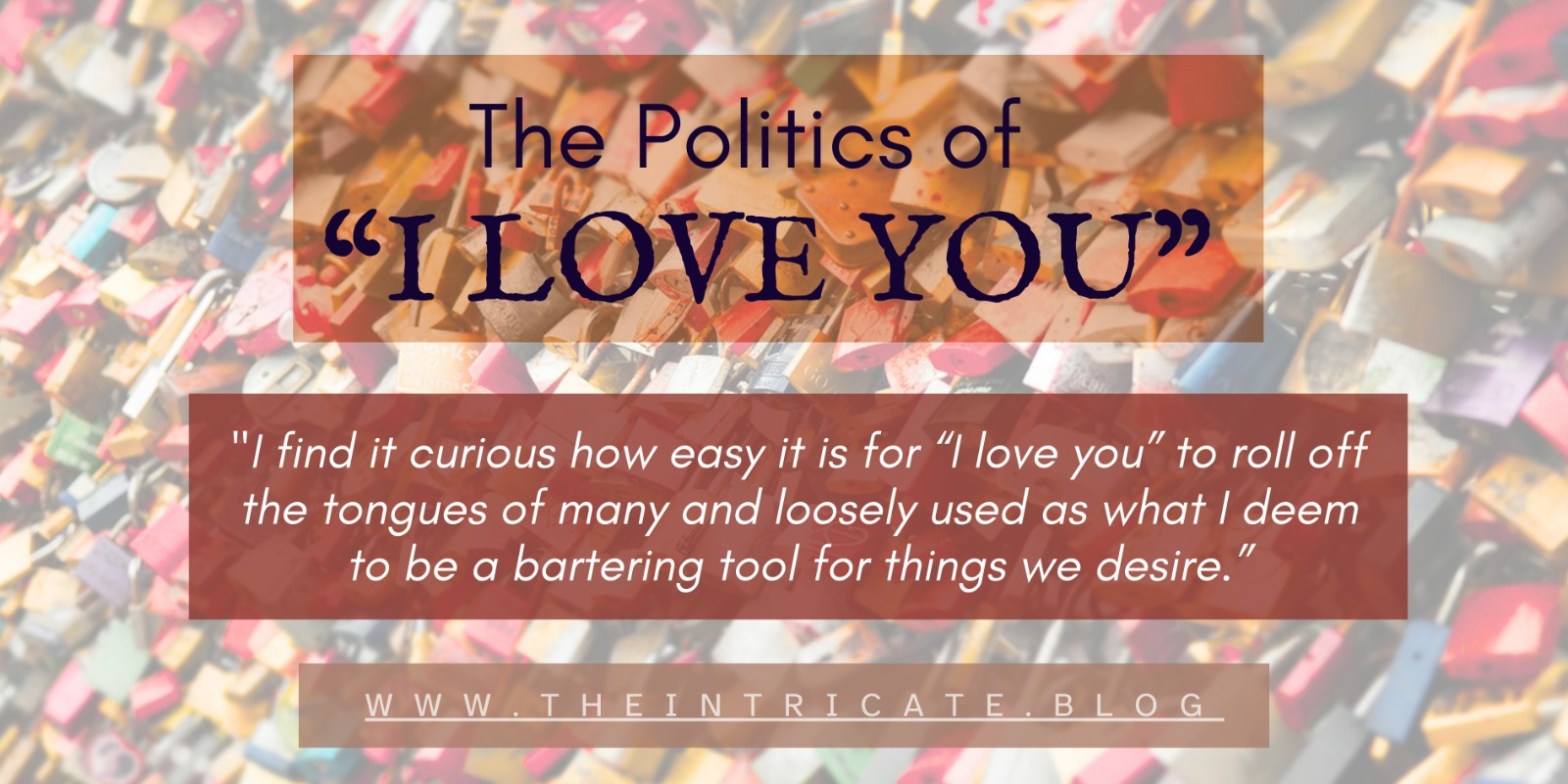
The politics of “I love you.”
• Supervisors love a worker who overextends. The moment that worker protests and insists on equity, the worker may be accused of insubordination, and the once model worker becomes a problem that needs to be eliminated.
• Constituents love politicians who provide handouts during election season and hate those who refuse to pay for votes.
• Children love the parent who allows them to have their favourite candy in abundance and shows disdain for the other parent who rations their intake for their long-term health.
• A man loves the woman who allows him “to be” without murmur. The woman who requires and demands accountability and respect typically ends up being booted and/or denigrated.
• Women love the man who provides the lifestyle that showcases the trappings of success; the minute he cannot maintain that which she believes sets her apart, she wants nothing to do with him.
• Friendships end with the introduction of boundaries
This is the nature of the human interaction where “love” is explicitly or otherwise declared. Our “I love you’s” take effect or is prolonged only when others operate according to how we believe they should. Fortunately for me, Viris Donaldson, my grandmother (RIP), remains my earthly benchmark for love. She didn’t consider herself beyond reproach and though she never once said “I love you”, her overall posture toward me embodied 1 Corinthians 13:4-7 (NIV):
4 Love is patient, love is kind. It does not envy, it does not boast, it is not proud. 5 It does not dishonor others, it is not self-seeking, it is not easily angered, it keeps no record of wrongs. 6 Love does not delight in evil but rejoices with the truth. 7 It always protects, always trusts, always hopes, always perseveres.”
My interest in the loose use of “I love you” came about some time ago based on my observation and on the lived experience. I find it curious how easy it is for “I love you” to roll off our tongues because people understand the power of those three words, so much so that most become excited at its expression without evidence of it. Conversely, as quickly as it is said, people are even quicker to withdraw their declaration if responses do not match their expectation of how it should be received.
After sitting with the topic for several weeks, I came upon a podcast in mere happenstance titled, “Do we love like Jesus.” My initial thought was that the podcast gave language to much of what I observed and brought to the fore some uncomfortable truths that I believe many of us (Christians) will not readily admit. I identified because in my quest for holiness, I am constantly praying Psalm 139:23 and Psalm 51, because I recognize that I need daily help to be more like Christ. For example, as an introvert, I don’t always want to interact. However, the significance of a church community dictates that I must do more than extend my resources. As I listened intently to the podcast, I also found that the points raised are reminiscent of believers who vocalize love. Well, obviously, since this podcast intends to reach Bible-believing, Sunday-morning (or Saturday morning), church-attending Christians .”
Some of the applicable points raised are:
“….We love being truth-tellers, but we do not love the people we are telling the truth to.” A few blog posts ago, I wrote about adjusting one’s posture to match one’s intention so that people can experience love (through us) as God intended. The challenge is that many of us believe that if we are extending our resources, regardless of the accompanying unpleasant posture that people should accept that this is an act of love, despite how our posture might make them feel.
“We are not honest with ourselves about our weaknesses…. I am afraid to admit I do not love people, because it makes me feel like I am a sinner.” Yikes! Many of us are, indeed, afraid or too prideful to admit that we are weak in many areas of our lives. To extend or even ask for grace and forgiveness, we must first acknowledge that we do not necessarily want to do this because of how we may feel about each other, even while declaring love. It is true that some of us do not like our brothers and sisters in Christ. For some, anyone outside of our church clique is unwelcomed or treated with obvious disdain.
“The confession releases you from that thing so you can receive God’s power.” Obviously, an admission of anything (we struggle with) is usually the first step to repentance, which leads to transformation and makes us like Christ. Unfortunately, fear, pride, unaccountability and lack of love prevent us from receiving God’s power.
“Some people struggle with lovelessness.” It is true that everyone has a vice. And it is especially true that every believer sins against our brothers and sisters in ways that express lovelessness. The problem is that many won’t see it as such because we have defined for ourselves “love,” instead of being guided by 1 Corinthians. In our minds, our human articulation and showcasing of love, based on what we deem it to be, should be enough to sustain relational activities. When in truth, it requires allowing the Word to be our daily guide.
“I have relational weaknesses, which presses me into dependence – into God – to listen, to love, to care, to be compassionate.” Maybe if more of us in the community would admit this, our ability to love would improve. As for me, I identify (with having relational weaknesses); therefore, my reliance on God is ten-fold. I am aware, every day, that I cannot (nor do I want to) navigate this world without Him. I need Him daily to express love.
As the podcast came to an end, the guest concluded that, “we all have sins that we cannot shake… for some it’s lying, pornography, lovelessness, selfishness, anger, impatience….” If we accept this to be true, I believe it will be easier for us to be mindful about our execution of love, as God intended it. I can’t help but think deeply as I kill my flesh daily.
On her last visit home, my daughter pointed out to me that I had caused her hurt. Instead of immediately accepting her lament and apologizing, I found myself negating her experience on the premise that “I have always loved” her as if to say I should not be held accountable for this specific “wrong doing.” As I sensed her disappointment for my initial response, I regrouped and gave her a real listening ear, then offered a sincere apology, which validated her experience with me. The fact that I have been my daughter’s support system and have given her my all does not excuse or exclude me causing her pain. In fact, I have caused her pain despite all that I believe I am and have been to her, and I must respect her for pointing it out. I must also apologize and correct how I proceed with her. It is important to me that she feels my love – not just of last year or yesterday, but in all my interactions with her. Truthfully, she had every right to feel how she felt by my actions, because it did not present as love. The reverse is also true that we those of us who have been hurt even in those “loving” relationships must understand that people will do things that are unloving.
My observation about our community is that many of us believe that because we have extended ourselves in ways we deem grand, that should be enough to sustain the relationship, regardless of our blunders. In that way, we operate as if we are beyond reproach. But for love to reign, there must be honesty, openness, and a willingness to self-evaluate or to be evaluated by our brothers and sisters in Christ; otherwise, the space will be unsafe. As in the case with my daughter, though I have spent twenty-one years echoing “I love you” sentiments, I do not always operate in love. As I was recently reminded, sustainability of that relationship, as important as it is to me, calls for my humility, accountability, and introspection, which allows her feelings to be validated in that space. Accordingly, it is my sincere hope that with my intentional quest to be more like Jesus, she will know and ultimately be confident in my love in the same way that when I cause her hurt, which I am positive I will again, I will be contrite and offer a genuine apology as I adjust the ways in which I re-present.
As I explored the topic through the writing of this blog, I am reminded that:
• A person cannot truly love if they do not know God’s Word.
• Though “I love you” is an excellent bartering tool, it is weak on its own if love is absent.
• It is not in our nature to love ALL THE TIME. Sometimes our flesh wants to hold grudges, to be unkind, and keep tabs of hurts, etc. The execution of love relies on the daily killing of our flesh and the Church community to hold us accountable – to serve as a mirror – our reminders of what is required of us.
• We are more inclined toward the performance of love than we are our actual heart posture.
• When relationships exist within the confines of just two people (platonic or otherwise), i.e. without outside interaction, we often do not know how a person will respond when other variables are introduced. It’s like the Love is Blind effect: interactions appear genuine when the two are focused on each other. However, as soon as the pair is back to “normal life,” people stop performing and start being themselves. The outcome of this is either the solidification of their bond or the dismantling of a foundation built on a facade.
Ultimately, while we may successfully politicize “I love you,” we certainly cannot politicize Love; “I love you” and Love are not one and the same. Love is of God which is not up for the grabs. We either love or we don’t, regardless of how beautifully we say it.

 PARENTING, ADVOCACY AND EVERYTHING IN BETWEEN
Very interesting perspective on love and “I love you.”
This post serves as an affirmation for my ideas of love and the choices I’ve had to make concerning the matter.
Have no doubt it will serve as a food for thought stimulus for many, as they seek to align themselves with God’s character, love.
R. Semone Powell