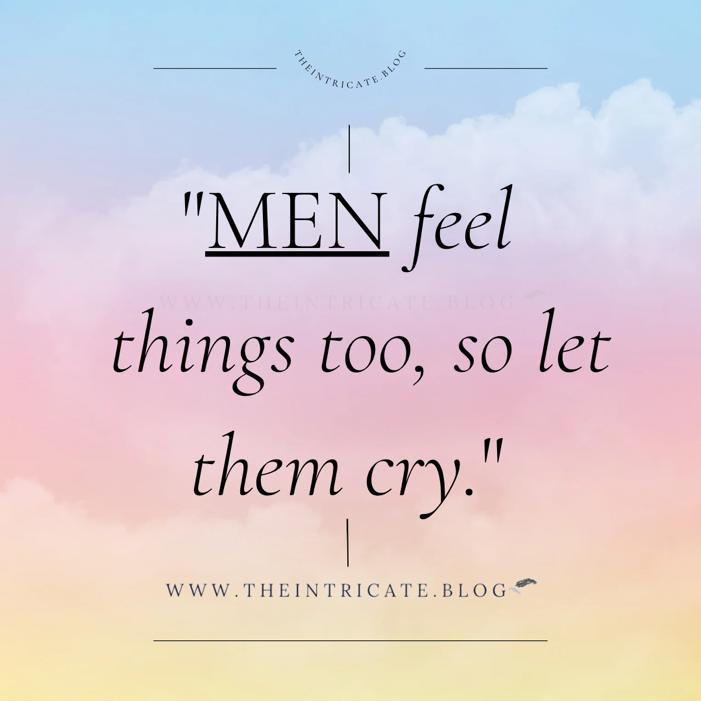
He is huMAN; let him cry!

I happened upon a snippet of a poem by T’Sleeveless on Instagram, called “Teach A Boy To Cry”.  The few lines I heard caught my attention, so I went in search and found it in its entirety.   The poem, so raw and beautifully executed, articulates what I have always argued to be how most men feel about the expectations that society has thrust upon them.   Ultimately, they all want the same thing – allowance to be and feel how they do at their core, without being labelled weak or unmanly.  

Needless to say, many of the ways that men have been taught to love and execute masculinity are problematic and toxic with devastating outcomes; this leads to a vicious cycle which is passed on from generation to generation.  The perpetuation of toxic masculinity is rooted in the fear of being chastised and seen in a manner that renders them anything other than what society instructs.  Essentially, toxic masculinity dictates how he should be:

  1. He has been told that he MUST be strong – that crying is weak. When he suffers loss of any kind, he should “man up” and avoid vulnerability, which include withholding his tears and any other manifestation of pain that could be deemed as feminine energy.  Because of this, men are forced to perform strength through acts of violence, caused by the lack of problem-solving skills.

The outcome is that he ends up with unresolved emotions/issues with pent up anger that is usually released in less than favourable places and ways.

  •  He has been taught that a woman’s love must be accompanied by sexual favours.  If it isn’t, his interest wanes, and he quickly move on to the woman who will fulfill this expectation.

The outcome is that he ends up with transactional relationships with females that are typically void of real friendships, or worst, he ends up contributing to the rape culture.

  • He has been told that to have one woman is weak.

The outcome is that many men have associated their self-worth to the number of sexual partners.  In his mind, once he “gets it”, his self-worth increases and so does his value among men, so he continues on this trend, thereby decreasing his lifespan.

The outcome is that he is empty and lacking real support with foundational value from the relationships he pursues.

  • He has been told that to treat the woman as equal contributors to life in general is weak; he learns that the woman is beneath him and that she should occupy a certain place and operate in specific gender roles, which ultimately renders her less than him.  The outcome is he continues to perpetuate misogynistic ideologies in the workplace, among his peers and at home.  Ultimately, women typically come to their own realization about what is acceptable, in society in general, but especially in relationships and end up leaving, if not physically then mentally and he ends up leaving from relationship to relationship.

Despite what he has been taught, and how much he tries to fit in so that he is playing his role well, those of us who pay attention know that the man who operates in awareness of himself, despite societal dictates, feels deeply and wants what the rest of us wants – to be at peace and to have a life free of drama – one that is consistent and stable – and we are not talking about a life where women stay hush about indiscretions (on the job, in his personal or public life) and does not hold him accountable.  They, like their female counterparts, want to be seen AND accepted for who they truly are, without the emotional restrictions that have been placed on them.

T’sleeveless, who describes himself as a “mental health poet,” explores the male dynamic by highlighting the notion that most men are afraid of opening themselves up and showing the pains they experience out of fear of how they will be perceived and received.  That, for me was the thesis of his piece and central to the toxic masculinity ideology.  He asserts that the “manufactured masculinity,” while dangerous, is what is expected but the effects of which are lonely because while society judges what men have become, no one deconstructs how they have become who they are.  He further states that the man has become accustomed to using jokes as a conduit for his pain because his pain “has to be transformed into an art form to be worthy of observation.”  Men have been taught that pain is private and to outwardly express pain is a sign of weakness.  Because of this, the man’s go-to expression for any type of emotional/mental discomfort is to engage in a physical war or to suppress how he feels from fear of being ridiculed.  As T’Sleeveless points out, “nobody taught the boy to cry, but they taught him how to fight.”  This observation of toxic masculinity is seen in every space the male occupies; for example, he teaches his sons what he knows, and the conversation among his friends and colleagues perpetuates this dangerous narrative.  Furthermore, women end up expecting this “strong man” ideology without understanding its dangers until she herself suffers at his hands or she ends up raising a son to become a man she would never date, in her quest to raise him to be “strong.”

As T’Sleeveless aptly puts it, “everybody judges the weak man, and nobody checks on the strong one.”   The conundrum seems to be the ways in which to change the mindset of all in the face of what is generally accepted to be masculine:  He doesn’t cry; he fights.  He doesn’t constructively address his losses, he quickly moves on from them.  He doesn’t partake in any activity that may render him feminine, he subscribes to gender roles, even when they do not make sense for his unique situation.  He suppresses emotions in his effort to appear tough; though he yearns unconditional love, he confuses the act of sex as a care indicator, and the list goes on.

Who then is the strong man, and who is weak?

Like the poet, Latteras R. Whitfield from The Dear Future Wifey Podcast bore his soul by highlighting his recent heartbreak and its impact on him, which he openly said was caused by a failed relationship.  The episode, which has been viewed approximately two hundred thousand times by people all over the world, garnered hundreds of comments from men and women who applauded him for his refreshingly honest bravery (he openly cried during the podcast) by thanking him for using his personal situation to bring awareness to what men experience in REAL LIFE, which many viewers (male and female) believe will encourage more males to express the truth of what they go through.  One of the toxic traits highlighted from the comment section is that most men, instead of being honest about the impact of a breakup (to themselves and others), would instead, quickly replace that pain/hurt with someone else, which many have admitted to be a lonely and dark space riddled with the lack of self-esteem and self-control, which many have also admitted is less than what they make it to be.

Hopefully, as T’Sleevless through his poetry, and Latteras R. Whitfield through his podcast, continue to shed light on the TRUE experiences of most men, we will see a shift in the expression of masculinity to that which is more positive and indicative of that which will allow us to redirect our thoughts on what it means for the men to be masculine.  As I imagine it, a man who operates in his awareness of his pain and struggles, regardless of his orientation, and is not afraid or ashamed to acknowledge them by crying if he needs to, and is working on making himself a better version of himself for himself, his family and the wider society and one who doesn’t have to hide his pain, needs and desires because of an ascribed gender expectation, is a “strong man.”  The man who respects himself, his family, and the wider society and who is not contributing to the demise of an individual or community is a strong man.  The man who is not afraid of his tears, despite what he has been forced to believe, is huMAN.  For this to happen, however, there needs to be male/female collaboration toward a changed mindset, which may also include deconstructing the notion of toxic femininity and the ways in which this works in perpetuating toxic masculinity.

KNOW yourself so you can “NO!” them.

“You are a whore!” 

I guess this was her way of operating in her flying monkey role; she was on the attack and wanted to hurt me, in any way possible.

Though my interaction with this woman was very minimal, to say the least, she felt it necessary to do so, at the instruct of someone else.  The first time she attempted to define me, I laughed because I knew this was part of her continued efforts to denigrate and frustrate me.  But it wasn’t a real laugh.  It was the kinda laugh you do when you are beside yourself with shock and anger.  At the time, I didn’t understand how any of this worked, because I hadn’t begun my learning journey about things of this nature.    I just figured that this is what many women do, unfortunately, when we want to hurt another woman; many use the vilest words to attack the target, especially against the thing that they assume she holds dear.  Needless to say, by dictionary definition and by societal standards nor the standards I set for myself, a whore I am not.

Be that as it may, one of the things I have learned from being the target of a long-term smear campaign is that you must be resolute in who you are and stand firm in that.  A smear campaign, by design, will break you if you do not truly KNOW who you are and how to operate in that knowledge of who you ARE.  The beautiful thing about coming to that level of self-awareness is that once you are there, you are UNSHAKEABLE and UNBREAKABLE.  But, it takes work, which involves uncomfortable honesty and which can only occur from deep introspection, self-evaluation, and acceptance.  Once this occurs, you will have come to terms with every aspect of who you are, which involves the good, the not-so-good, and the bad.  This is typically done when a person wants to improve themselves and ultimately be better to themselves and the people in their lives; it is also done by those who are serious about validating who they already know that they truly are, despite what people try to make them out to be.  Be mindful that both reasons can exist simultaneously.

For those of us who are truly interested in being “better” to ourselves and to others, the process of getting to a space of self-awareness is a complexly interesting and scary one, because, in the end, we don’t always like what we see (arguably, no one is all good, and no one is all bad).  Furthermore, most of us are also not sure what to do with what we discover.  Now, that is where the real work begins, regardless of where our discovery falls on either end of the spectrum (good or bad).  Let’s think about this before we throw it out the window.  For example, the good that we may have discovered may force us to walk away from situations that we deem to be our comfort zone, the same way the bad may dictate that we “fix” ourselves so that we can sustain that which is important to us.  None of it is easy.  To say that we are all flawed is like saying we are all human beings – we know this; they are one and the same.  The problem is that some of our “flaws” are more detrimental to ourselves and to others than the discovery of a “simple” issue.

The point is, regardless of what happens after self-discovery, it is important for us to KNOW who we are, that when the agenda-fulfilling among us attempt to incorrectly define us in order to hurt us, we are not fazed because we either KNOW exactly who we are (good or bad), or we are on our way to self-betterment.  Let’s face it, liars KNOW that they are liars, and a thief KNOWS that he/she is a thief.  While they likely will not readily admit it, they KNOW, even while not understanding the “why”.  On a more complex note, there are other traits within us that require digging (meticulously scrutinizing) for us to truly KNOW what defines us.

The benefit of the knowing process is that though some of us may be exactly what they say we are, we would have already gotten to a state of self-acceptance, so it cannot be weaponized.  It is my belief that for us to address a thing, we must first accept it to be that thing. For example, even if you are, in fact, a “whore” or any other unpleasant definitions that they attempt to let stick, no one can use it against you, because you would have begun the process/work of delving into that specific thing (good or bad) in a way to understand and establish several things, such as:

  • why am I the way I am?
  • Is being this way beneficial to my growth?
  • Is being this way harmful to the people in my space?
  • Am I harming myself by being this way?
  • What steps do I need to take to depart from my ways?
  • What steps do I need to take to enhance my ways?
  • What do I need to do to commit to my personal growth?


In the end, when we KNOW who we are, no one can define us or use what they don’t know or know about us as a weapon against us.  Even if they do, we will be able to reject all notions, which doesn’t always require “noise.”

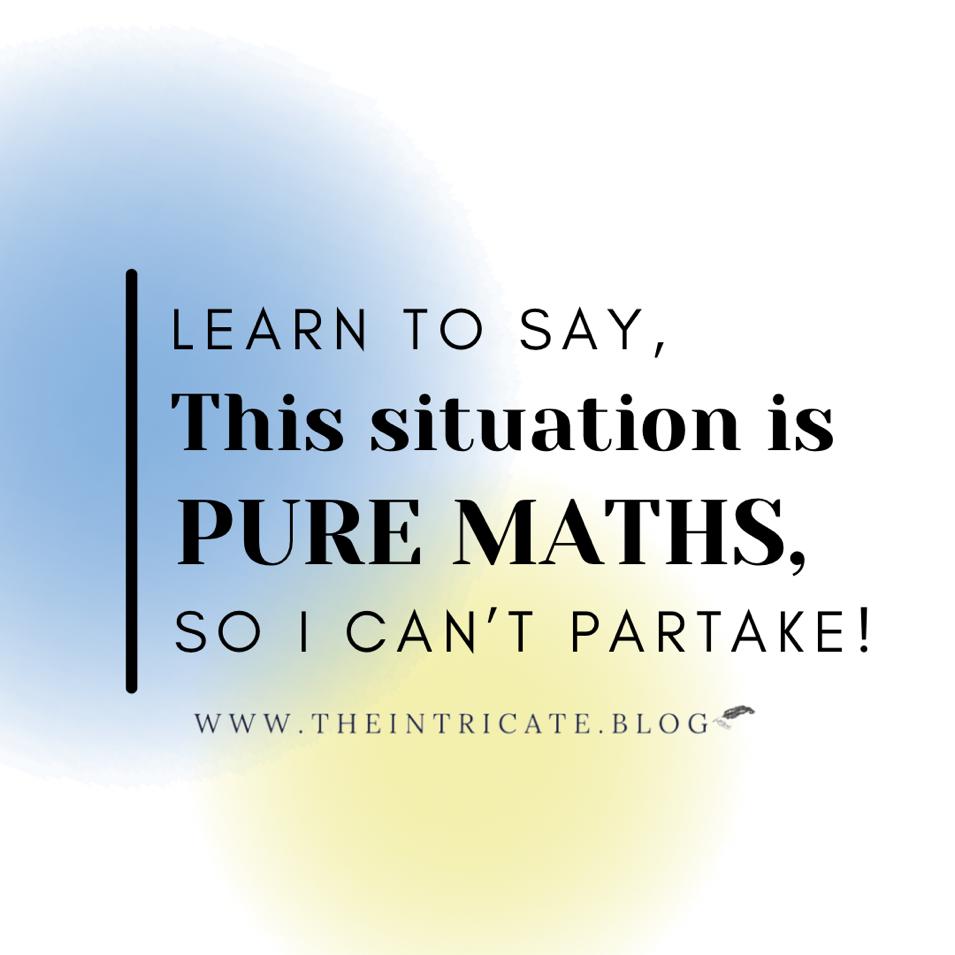
Shhh! This is PURE MATH.

The pandemic did many things that hurt, but it also provided access we wouldn’t normally have.  For me, I was able to have intermittent fly-on-the-wall experiences with my daughter’s classroom shenanigans and serious discussions.  Having to go to work and school from home gave many parents that type of access, regardless of how big or small the home space was.

In my case, the offspring decided that she would “attend school” at the dining table.  This was part of her way of breaking up the monotony of always being in her bedroom.  It worked.  Except, there would obviously be times when I was in the kitchen preparing breakfast, etc. while class was in session.  While I tried my best to not “be present,” there were times when topics of discussion among teachers and students would pique my interest, and I would intentionally pay attention.   From time to time, my observations would form part of a discussion that either I or my daughter would later initiate about whatever the topic was.

In my usual fashion, I gingerly navigated the pots and pans to minimize the disturbance to her “classroom.”   Although my daughter was having a robust discussion in English with her teacher, I realized, on this particular occasion, I could not grasp anything they were saying.  Despite me having mastered English – the concept, the analogies, the examples, and the problems being presented in the discourse were way over my head.  There was nothing in my degrees that prepared me for understanding the banter between pupil and teacher; I was out of my element.

They were having a Pure Math discussion/debate.

The context in which I operated is simple.  In high school, a few decades ago, I, along with a few other students, was approved to do the Basic Math external examinations, while other students were doing General Math.  The difference between the two is vast from my perspective.  In layman’s term (which is the best way I can explain it), being approved for basic math meant you were, for whatever reason, math-averse/dense (or dunce); while general math meant that you were able to grasp major concepts with greater ease.  Us basic math students could add, subtract, divide, multiply, and do simple worded equations that didn’t necessarily require formula application that the math gurus would have mastered.  Even so, I ended up failing. 

As I listened to my daughter banter with her teacher, whom I could tell was delighted about the exchange (every teacher wants the student who is excited about learning), it became pretty evident to me that I did not possess the brain capacity to understand.  If this wasn’t a metaphor for life, I don’t know what is.

HEAR ME OUT, PLEASE:

We often find ourselves trying to interject our ideologies in situations that are beyond our capability.  The fact that we may possess the gift of gab or just the mere ability to speak doesn’t automatically qualify us to provide feedback on every issue.  There are some things, that regardless of our educational achievements or proximity to the thing, we simply do not have the brain capacity to understand.  

This also extends to the validation we often seek from those we have no business seeking validation.  We crave the approval/assessment of our “pure math” problem by someone who barely grasped “basic math.” 

“STOP IT! GET SOME HELP!”

The simple truth is that some person’s capacity to deconstruct a situation can only occur from a basic math perspective, when the situation, and what it presents, is occurring in the “pure math” space.    This could be for a myriad of reasons to include the following:

  1. Lack of context:  If we do not have the necessary information, it is difficult to understand what is happening in the situational equation and therefore we won’t be able to provide useful feedback necessary to solve the problem or make an effective assessment.
  • Personal biases:   How we feel (attitudes/beliefs, etc.) about a person, place, or thing (whether intentional or unintentional), often prevents us from accessing that fair space; thus, when we interject our thoughts and/or opinions, it is often occurring from a limited and/or compromised perspective. 
  • Dishonesty:  a person who is naturally dishonest and operating from their own agenda-fulfilling space is unable to effectively contribute.  The conundrum is that another person who is operating with a basic math brain capacity may think that the person who articulates well (but also has a basic math understanding) is offering sound advice solely on the premise on who they perceive that person to be.  So they are both operating with a basic math background, except one is posing as having pure math understanding.  Make sense?
  • Lack of awareness/exposure:  if we don’t have access to a thing, have not been made aware of a thing, have not gone in search of the REAL truth about a thing, or attempt a knowledge-based deconstruction of a thing, we cannot speak on or assess such a thing.  This is true regardless of who we think we are against the backdrop of our “achievements”.  Our lack of awareness/exposure of that thing makes our understanding of that thing (pure math) tantamount to having a basic math education.  We remain CLUELESS.
  • Do not possess the natural propensity:  There are some things that are just not for us; it is as simple as that.  Some people can draw, some can sing, some can dance, some are gifted engineers, some are great orators, and the list goes on.  Some people are naturally great at some things, while others find that same thing the most difficult thing to grasp.  It is just the nature of human beings.  We all serve different purpose.  So what is “pure math” for some, is “basic math” for another; and what is “basic math” for one is “pure math” for another.

THINK ON THESE THINGS!

Many of us are falsely led to believe that the level of our education, access to resources, or status in life/society, gives us the automatic edge to effectively participate in every discourse.  IT DOES NOT.  I can’t say this enough:  CONTEXT IS IMPORTANT TO CRITIQUE.

There are many “Pure math” instances in life that our circumstance (background, dishonesty, lack of awareness/education/understanding, lack of context and personal biases, etc.) may disqualify us from speaking on/about/for/with, etc.  This include ANY SITUATION THAT WE ARE NOT PRIVY TO (parenting, your friend’s marriage, introversion, your neighbour’s relationship, your co-worker’s homelife, abuse patterns, narcissistic abuse, mental illness, religion, the Bible, relationship dynamics, etc.).  This list is obviously not exhaustive since no one tells anyone everything.

It’s like being given an assignment with two parts.  The lecturer tells the student to read the case study (part A) and then answer the questions that follow (part B).  Even though the questions are written in a language that the student has mastered, he/she is unable to provide USEFUL feedback because the student DID NOT READ THE CASE STUDY.  The student can make something up that someone else who also has no context will believe to be true, solely because they sound good saying it; But guess what happens in the end?  The student gets a failing grade from the teacher.

Even though my offspring lets me know that Pure Math is not as hard as I think it is, I am still not able to participate in Pure Math discourse nor can I solve the equations because I have not done anything to access and/or understand its abstract concepts nor have I made any attempts to know anything more than its name – that it exists (or does it?).  Plus, PURE MATH isn’t really my thing, and it sure aint my business. LIFE IS EXACTLY LIKE THIS.  When we insert our limited understanding into things that are obviously bigger than us, we exacerbate situations. Therefore, let’s learn to stay on the side-lines and listen to those pure math conversations/scenarios, etc. that our basic math exposure and/or brain capacity prevents us from actively participating in.  Maybe we can learn something in the end, or maybe not.  Either way, hush!

GET A “PEACE”….. PLEASE!

The pandemic did more than wreak havoc.  It changed my trajectory and forced me to operate outside of my usual modus operandi – to take control of my potential and create according to God’s instruct.  With this, the experiences of the pandemic were translated to about thirteen pandemic-related poems.  At last minute, I decided that these poems would not be included in my first anthology but would, instead, be placed in a separate publication.  This was me, once again, following a leading greater than myself.  I listened.  In March 2021 my first anthology of poems was published.

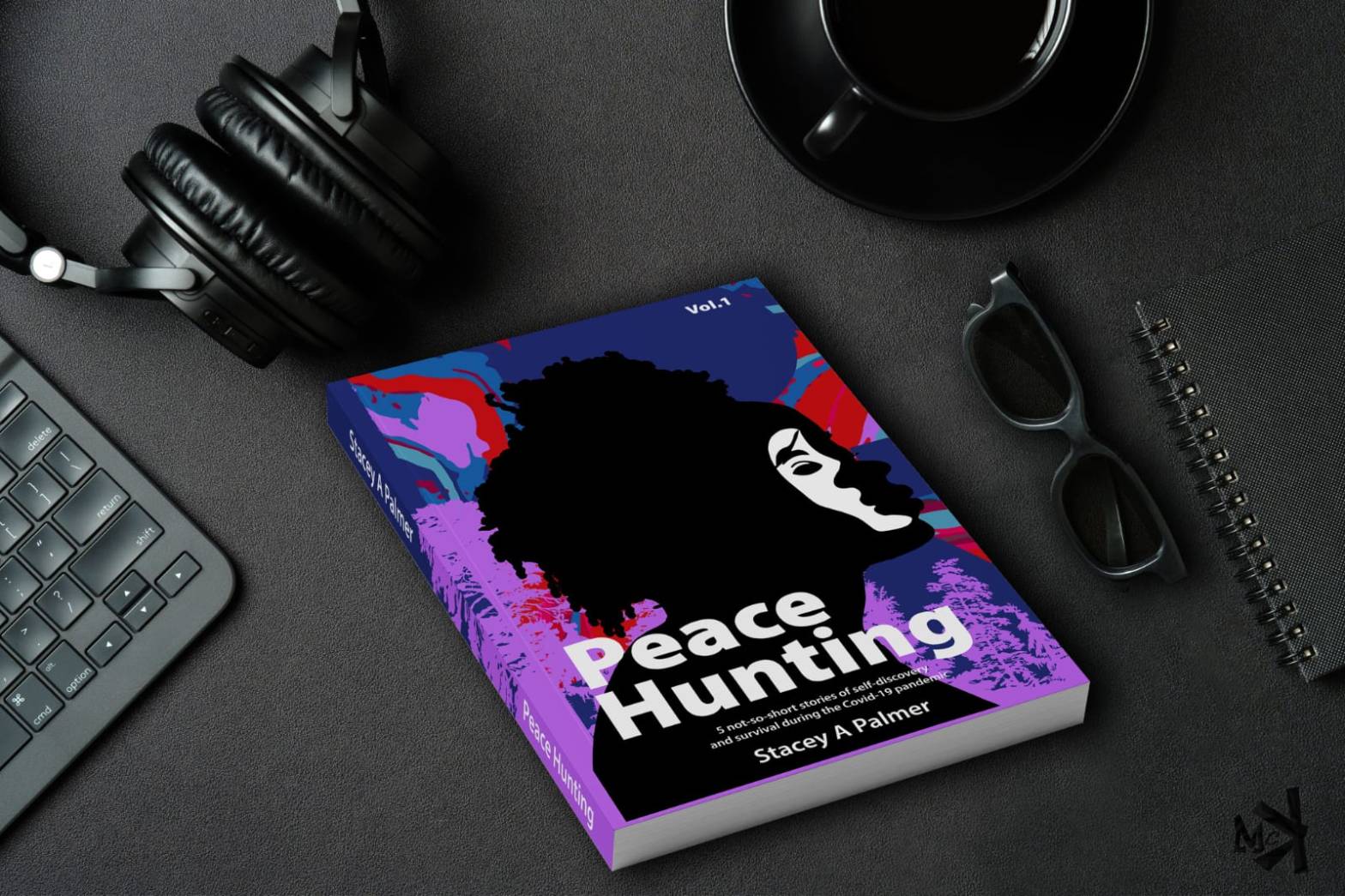
Fast forward, to June 2022, and I published my very first book of not-so-short stories; seriously though, they are more like five novellas in one book, since the stories range from 50 – 60 pages each.  Peace Hunting, as it is called, came about because I had a premonition – a leading – a nudge – a voice that instructed me to write poetry-infused short stories chronicling the pandemic, in some way.  I had no idea the direction the stories would take.  At first, I thought I would have written ten stories, but then I decided that five would be enough since my imagination was leading me down a different road than what categorizes “short story.”   Interestingly, I didn’t look at any of the poems while writing the stories, but as fate would have it, they somehow fit, and the book, PEACE HUNTING, was born. 

One of the overarching themes about the book is each character’s quest to find some sort of solace – to become better human beings – to escape their old self/life and pivot in a better state of being.  Simply put, they were all searching for peace of some kind.  This notion of peace hunting is something that I have also observed in real life.  Everywhere you turn, every guru who seeks to motivate and change lives, every human who is going through the hardships and the challenges of the pandemic, are all advocating the same thing:

WE WANT PEACE!  WE WANT PEACE!!  WE WANT PEACE!!!

Admittedly, this is something that I have been advocating for myself in the last four years – relentlessly so.  As I discussed the title with the team a few months ago, it occurred to me that the most suited would be PEACE HUNTING, since I, too have been talking about it, advocating for it, and trying to live it.  Even so, what made the title choice even more serendipitous is the fact that one of the poems, written a little over two years prior, “Force Faith” actually has the phrase “Peace Hunting,” which is the core of that piece.  This, I only realized after I had decided on the name and was finalizing the book.   Amazing!!!!

As I promote this passion project, I encourage all readers of this blog AND the book to find ways to navigate those “life-disrupters” and “pleasure-hurters[1] that interfere with your peace.  The book’s preface provides an in-depth explanation of peace-hunting as a concept; this (preface) can be read in its entirety on  https://www.amazon.com/Peace-Hunting-not-so-short-self-discovery-survival/

Get this:  In our own peace-quest, we must also be mindful that we, too, are sometimes causing grief to others and disrupting peace.  Therefore, it is important to TRUE peace-hunting to introspect as well as change course and become better to others, so that they too can experience the PEACE THAT WE ALL SEEK AND NEED! 

NamaStacey.


[1] From the poem, “From Fear to Hope” in the book PEACE HUNTING by Stacey A Palmer

NUFF SELF-RESPECT!

The “respect debate” is an ongoing one that continues to evoke passionate responses from us, once we feel like we are advocating for what we should accept from others as well as how we are required to treat others.  However, the conversation is not as loud when we should advocate how we should treat OURSELVES.

Respect begins with SELF. 

Recently, I placed myself in a situation where I interacted with a group for about 45 minutes.  Prior to entering that space, my gut told me that I shouldn’t have, but I convinced myself that this was the “right” thing to do and went against what my inner voice (that which prays and serves God) forewarned.  The second I exited that scenario, I knew it.  I felt it loudly and I heard it as clear as day:  “YOU JUST DISRESPECTED YOURSELF.”  I disrespected myself when I agreed to be there and further disrespected myself when I showed up.

Admittedly, I was disappointed with myself, because I had no one to blame but myself for going against my discernment, which had, to that point, never steered me wrong.  I was also disappointed because I had prior knowledge about the group by virtue of lived experiences, and I did not let that be my guide and proceeded just the same.

I started to think of the many ways I could have foregone the interaction and things I could have said to not have been a part of something that I KNEW, before going in, I shouldn’t have.  I soon let it go because there really is no point belaboring the past for longer than it takes to garner a lesson from a situation.  For me, the lesson came almost immediately, and after a day of wallowing, I let it go – with my lesson in tow, of course!

My cautionary tale is that we must learn to respect ourselves by loving ourselves enough to say “no”, even when “no” is the unpopular thing to say.  Most times, people do not have enough CONTEXT to scrutinize our “no”, so we shouldn’t let someone else’ opinion about our decision guide how we operate.  Ultimately, our “no” may not make sense to others, and it doesn’t have to.  Once we are sure that we are operating in righteousness, which include, self-love, and self-respect, we shouldn’t concern ourselves about the noise of the outside world.

We all have standards that we have set for ourselves.  I argue, however, that the most significant and most basic standard we SHOULD set for ourselves is to TRULY LOVE ourselves.  To do so, we must understand what that looks like. 

For instance, not every situation that presents itself as an opportunity is that.  I have learned, first-hand, that the beauty of a closed door – even if we close it ourselves – often shows up as blessing.  In our quest, we must be reminded that toxicity does not always present itself as such.  Toxicity speaks well.  Toxicity makes promises to fulfill our needs.  It dresses well, and it presents itself in group think, sweet talk and pretty packages – toxicity is often well-liked.  To deliberately expose ourselves to toxicity, because of what it promises IS, in fact, disrespecting ourselves.

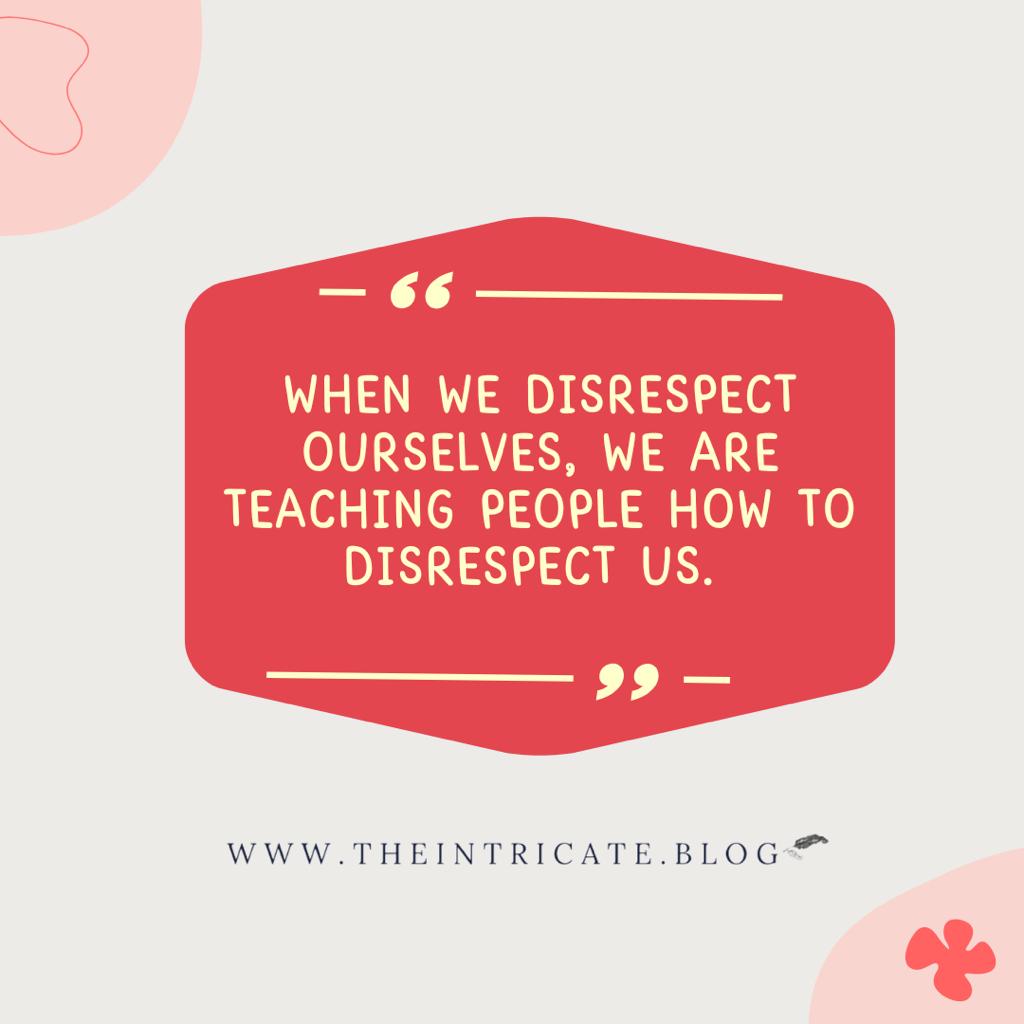
Respecting oneself is applicable across every single interaction we will have had in our lifetime.  When we disrespect ourselves by “showing up” to situations that do not serve us, we are teaching people how to disrespect us.  Be reminded, though, that “showing up” is not only specific to actual events, but giving people access to treat us in ways that go against who we are in Christ.  We are encouraged to stop letting greed, lust, lack, fear, status, etc., force us to disrespect ourselves.

We also disrespect ourselves when we don’t trust ourselves enough to honor our God-given talents to serve in ways that honor Christ…. But this is for a separate blog post.

Nuff  (SELF) respect!

MY GREATEST LOVE AFFAIR….

‘Tis the night before, and the world is preparing for the day when everyone gets to express how they feel about and to their loved ones.  Men and women, boys and girls everywhere are waiting, with bated breath, to receive those tangible expressions, so that they can ascertain the extent to which they are loved/appreciated/desired.  For many, the type of gift received is usually an indicator of the love gradient; it is what society has taught and what we have accepted as validation of “true love”.   Businesses, so inclined, have been prepping for what is not only the most romantic time of the year but is debated as being the most lucrative time of the year, since the expression of love at this time is not unique to any one class, race, group, or sexual orientation.  Bottom line, everyone, and their moms (but mostly dads) will be spending in their attempts to effectively express.

For some, this is no biggie, since this is the language of love that they have chosen.  As such, this time of the year is simply the icing on the cake for how they have been to their partners, and in this moment of Sacred Reciprocity, it is an easy and stress-free expression.  For others, not so much since this is when they are required to maintain a façade, which becomes problematic when the resources are limited.   But to each his own… right?  Loving someone and being loved in return and expecting a special treat on the day designed to show and tell is part and parcel of the love experience, for most, and nothing to be ashamed of.   Surely, not everyone requires that.  Arguably, it is a more uniquely different experience for those whose love affair is etched in something greater than any one person can give (and this has nothing to do with promiscuity). 

For me, I have had one great love affair that has lasted my entire life and that which transcends borders, race, moods, friendships, romantic relationships, childbirth, multiple degrees, heartbreaks, or an attachment to feelings or someone.  This love affair that refuses to quit, feeds my soul; it gives me motivation to achieve; it lifts me up when I feel down.  It guards me by reminding me who I am.  It never leaves me when I am sad and is a complement for my happy times.  It is patient with me; it finds me when I am lost and puts me back on track.  This love affair of mine takes good care of me and stays with, on, and inside me when I am existing in a space that no one else can penetrate and helps me to make sense of my existence when nothing else does. It is the one love affair that is the gift that keeps on giving all year long and one that I will always have no matter where I am and what I am doing and with whom I am doing it.   It remains with me through all my stages and travels with me throughout the most turbulent of times and places, literally.  Without my greatest love affair, I would not have been able to navigate those moments designed to break me – to beat me to pulp – into “disintegratory nothingness”.  

I cannot imagine existing without it – not even for a day, because affairs are sweet and exciting; they are intense and fulfilling.  This one is!  While they are supposed to be short-lived, mine isn’t.  Our relationship is sustainable and symbiotic.  It doesn’t matter what anyone tells me or who comes along, my love affair will be a part of every interaction – long or short term, so they may join us or opt to leave.  It doesn’t matter though, because my greatest love affair remains when all is lost – tried, tested, and proven.  Its only requirement is for me to keep it alive so that it may continue to thrive beyond times and borders.  This love affair is the one I have with MUSIC!  This is truly the only other thing outside of my relationship with my Eternal Father that provides an indelible and unshakable nourishment to my soul.  When I am one with music, I am impenetrable, unless I invite you there.  My love affair with music is my greatest love affair, to date and will remain my greatest love affair of all!

A word series: “INCONSEQUENTIAL”

I found the perfect work outfit, this time in a jiffy.  The blouse was easy to iron – the trousers, not so much, but all I needed to do was to get the extra creases out.  Nobody’s gonna know … how will they know…?   Once I have sat down to drive and have gotten up, you won’t be able to tell that I didn’t give it much ironing attention.  All’s well with the start of my day.

Anyhow, I am almost to the end of the ironing process – more than halfway down the left leg of the butterscotch “Next” trouser – when I saw it clear as day.  It was a yellowish stain – the type that comes from clothing sitting in a drawer for over two years not worn (darn you pandemic).  The stain was very deliberate too and perfectly patterned – as though it had a right to be there.  Having almost completed this task I royally dislike and having resolved my outfit for the day with great ease, what’s a woman to now do? 

In a split second it hit me! This yellowish stain sitting on the leg of my butterscotch trouser was INCONSEQUENTIAL, to me (plus, butterscotch and yellow are related in appearance, right?). Fundamentally, this stain will not affect my life in any way, shape or form.  I will have gone about my day not looking down at my leg as I walk, drive, interact, transact or banter.  I would have known that it is there, then forgotten and would not have cared. So I laid out my outfit on the edge of the bed and executed the getting-ready process as I normally would have.  Why would I have spent another 30 minutes to endure the outfit-selection/ironing process all over again?  I think NOT.

The day’s activities came and went! If the few people with whom I came into contact throughout the day saw it, none of them said anything about it – not that it would have mattered to me.  The fact is that my posture was one of normalcy and a little on the side of reckless abandon (in my mind’s eyes).    Nothing about the stain changed me or my perspective.  Furthermore, I have already deduced that literally everyone we meet has their own stain that they are trying to rid themself and often one that they hope no one notices. In my case, I decided that it was INCONSEQUENTIAL, so it would not have mattered if it were pointed out.

The point of all this is that there are many things/interjections that happen in our lives that are meant to derail the plans we/HE would have carefully made for us.  Some of them are so minuscule, but because of what we (over) think others will say about these things, we blow them out of proportion and make them into bigger things than they needed to have been in the first place.    My many experiences, thus far, have cemented that many of these occurrences/mishaps, etc. are INCONSEQUENTIAL in the grand scheme of things, and we literally need to get out of our own heads and dismiss them as such – inconsequential. 

Things happen…. Not everything is meant to be a big deal.

When those stains of life show up, there is no point looking down.  Why give your energy and attention to something that will not prevent your left leg from functioning as it normally does – taking you where you need to be.  We have to treat those stains for what they are – inconsequential.  But what does it mean for a thing to be considered inconsequential?  Simply, when something is inconsequential it is not important – it has little to no significance – in the manner that the stain on my trouser did.  If something has very little significance, we shouldn’t let it affect us and prevent us from functioning as we normally would.  It is not too difficult to learn when a thing is not important.  We simply have to ask ourselves a series of questions, within the context of our unique situation(s), for example:

  • Will this thing affect me/who I am in a real way?
  • Am I over-thinking this thing?
  • Am I living in my head and creating scenarios?
  • Is this a fundamental concern or am I making it so?
  • Will this affect the price of rice, light, gas, fish, medical care, etc.?

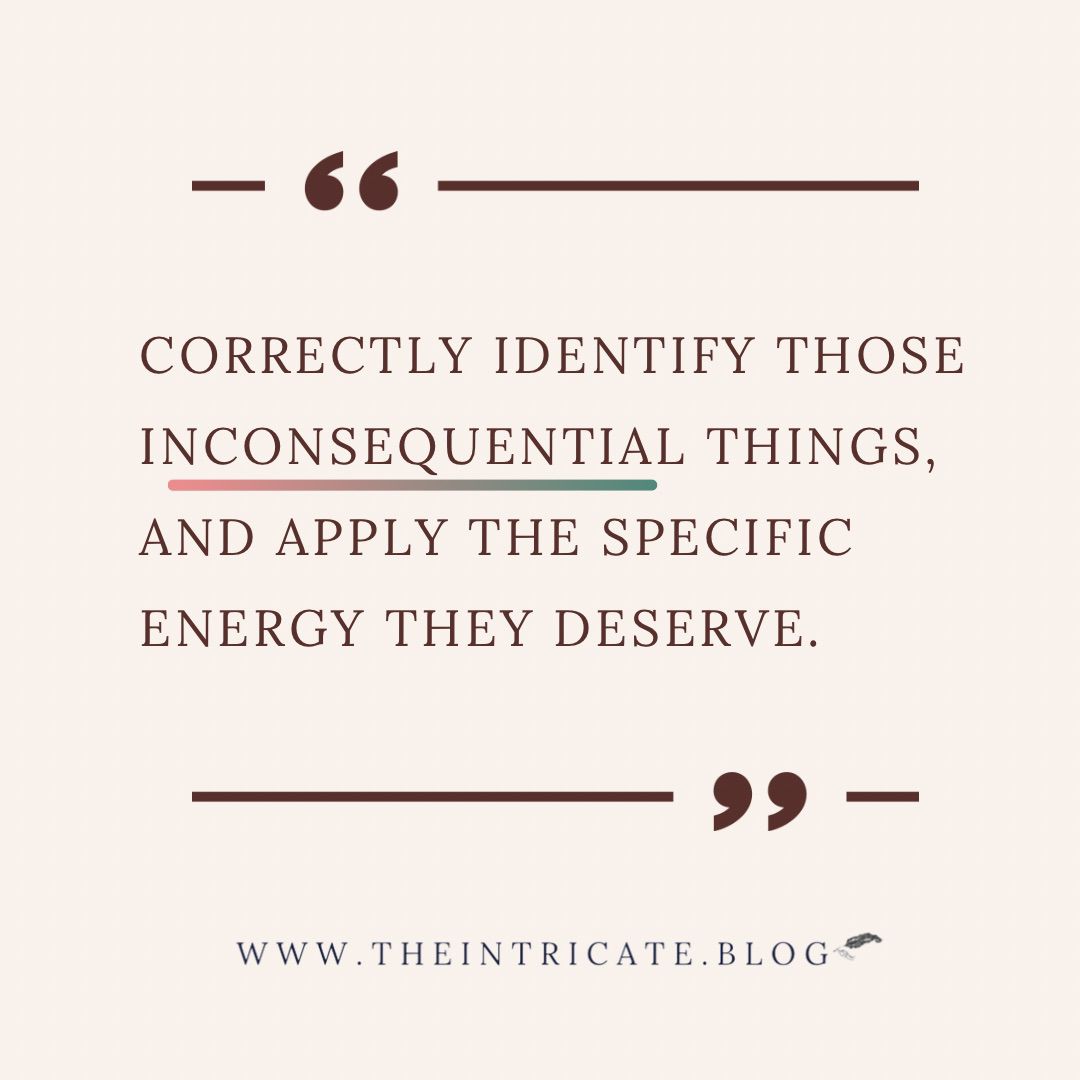
Accordingly, we must learn how to correctly identify those INCONSEQUENTIAL things and apply the energy they deserve.  For many, this may not be as easy, because we operate in our own heads and create scenarios that do not even exist, when the truth is that NO ONE CARES…. Fundamentally!  Guaranteed, if someone makes your stain a major issue, it is usually because they are masking their own.  As human beings, we tend to use other people’s “inconsequentials” as a shame tactic to create a distraction from our own crap.  In whatever capacity you operate – parenting, advocacy, your unique profession, love life, etc., decide now what your yellow stain on a butterscotch trouser is and treat it as such!   

I have since laundered the trouser but genuinely did not check to see if my inconsequential has been removed.  Matters not, because I like the outfit and will definitely be wearing it again …..

Unmasking the GBV Variant

The person who suffers psychological, financial and emotional abuse often feels lost and unaccounted for within a system that doesn’t give much room to speak about the trauma of this abuse variant. 

Within the context of Gender-Based Violence (GBV), what does a person have to complain about when they are not being physically harmed, right?

WRONG! 

The sinister outcomes of this type of abuse must also take precedence in the GBV discourse in every setting where GBV solutions are being negotiated and established, especially because the abuser has the tendency to acclimatize and morph into the appearance of “goodness” and “success”.  Consequently, anyone who experiences this should see themselves being represented into this conversation so that the shame and silence, because of this, can be forever erased.  After all, psychological, financial, and emotional abuse often leads to trauma with sinister outcomes that are hardly raised as part of the GBV discourse.  Aside from financial regression and poverty retention, the effects of financial abuse, for example, have other devastating impacts that are often not publicly unearthed.  According to Pentico (2015), “Financial abuse is devastatingly effective because it’s often not illegal, and it is an invisible tactic of domestic violence[1]”.

Despite this abuse variant occurring across socioeconomic groups and in all types of pretty spaces, THE SILENCE IS DEAFENING! Let us, therefore, re-present this evil and raise awareness so that this abuse variant can be given its dose of chastisement and solution that it deserves.  Let us also not wait until the “GBV Orange the World” campaign rolls around in November of each year; the solution-oriented conversation MUST be ongoing throughout the year.  Let us reveal this GBV (variant), for what it is!!!

While we figure out ways to do this, please enjoy/ruminate on the reading of Mr. Pen Man (which addresses the GBV variant), from the book of poetry, Fifty Poems with Zero Fs to Give by yours truly, Stacey A Palmer. 


[1] Director of economic justice programs, National Network to End Domestic Violence

WHAT CHOICE DO I HAVE?!

The universe has a way of aligning us with the things that matter and revealing to us those that do not.  Interestingly, the concept of CHOICE-MAKING has been chasing me in the last four months and presenting itself as the core of human existence – or at least an existence that is free from unnecessary drama, especially as I observe the way we are operating in or with the pandemic. Literally, every time I engage in a conversation with friends, acquaintances, etc. the discussion somehow boils down to making a choice, whether it be to do that which is RIGHT or that which “feels right”, for these are two different things, obviously….

…..Well aahm… this is not quite obvious.

From the moment we open our eyes to the moment we enter into deep slumber, we are presented with a myriad of scenarios in our professional and personal interactions that require us to make a decision to do one thing or the other, throughout each day.  The choice that we make, more often than not, alters our existence in some way, shape or form and can be the difference between misery and peace of mind – long term or short term.

Doing the right thing

The only problem with this choice-making necessity (and sometimes conundrum) is that it is not quite as easy as it appears.  Evidently, many of us grapple with doing what is right and what feels right for one reason or the other. The way I see it, that which feels right satisfies a hunger for instant gratification, whereas doing that which is right is specific to those things that provide long-term benefits that are usually in tandem with one’s spiritual, physical and emotional well-being and typically done for the greater good.    For example:

  • Because ice-cream is my vice, I am just gonna go there:  A person who enjoys and craves ice-cream may decide to eat one scoop once every three months as opposed to indulging whenever the desire for ice-cream is heightened (for an ice-cream lover this could be at any given point throughout each day).  One feels right, and one is the right thing to do.
  • You love your friends, but they are not a part of your bubble.  Instead of unmasking to laugh and chat, you keep your mask on while exchanging and having fun.  The love remains and you have possibly saved yourself and those with whom you reside, work, etc. the heartache of having to endure the effects of the virus.  Chatting and laughing unmasked feels right, but keeping your mask on is the right thing to do.  The greater good is being considered, regardless of the individual discomfort.

This is just two of many scenarios that could be analogous for almost every choice that we are required to make in life.  These scenarios also (hopefully) highlight the significant difference about what it means to do what is right and what feels right.

The Ultimate decision

Think about this; we always have an option (even when we say, “I never had a choice”).  Arguably, we may not always know what is right in every situation, because we do not always possess the mental fortitude to make that determination.  For many of us, however, the issue is about instant gratification often attached to a fear of missing out on that which we want to be a part.  We want the ice-cream all the time, because of how it makes us feel while eating it – the appetite for it is insatiable, so we ignore the long-term effects of (over) indulging; or, we do not want to offend our friends out of fear of interfering with the relationships, so we go against what we need to do for the long term benefit of ourselves and others.  Regardless of our dispensation, we know, more times than not, what we should do, ultimately.

I cannot imagine nor have I ever been a part of a day where making a choice was not required.  Life is about a series of choices; we are called to do what is right or what feels right.  Understandably, we all have a different moral/ethical compass that guides us and different things that motivate us on any given day.  Some will argue that what feels right is the right thing to do (at least for right now) and are therefore resolved with the consequence that follow. 

Whether we agree with the “right choice or feel right choice” ideology, the choice concept is applicable, regardless.  Whatever guides us, we are abound with choices in every facet of our lives, and we are still required to make a choice…. EVERY DAY OF OUR LIVES!

A Cliché Survival of 2021

By the end of 2020, everyone suddenly became a soothsayer and was foretelling what 2021 would entail.  As future-telling designers, we dressed 2021 in all sorts of pandemic-ending garbs and pre-celebrated all the things that we believed would have followed.  But 2021, like the woman who refuses quit with her three offsprings in tow, stripped herself of societal dictates and showed us that 2021 was going to do and be what 2021 wanted to do and be.  She forced us to change plans, to be still, to find ourselves, to introspect, re-imagine, to wallow in self-pity or to pull ourselves up by our bootstraps and live.  Whatever the case, if you are reading this, you have made it through 2021 and have started to make your way into 2022.  Hopefully, you will have learned that the plans you have for the year may not always manifest in ways that you imagine them to be.  The fact is that they could go horribly wrong, or they may end up being better than anticipated, regardless of the hardships that we may encounter.

For me, the challenges of 2021 came out swinging, but so did the reasons to celebrate.  If anyone told me at the start of 2021 that I would have completed/accomplished the things I did by the end, I would have said a resounding, “NO SAH”.  Now that I am sitting on the opposite side of self-doubt and major drawbacks that came as a direct result of the pandemic mania, I am realizing that clichés are more than just overused phrases/words that we are instructed to avoid when writing; they do ring true and can literally guide us through hard times.  So, I am choosing to be defiant (the same way 2021 was) and incorporate them here the way I did when manoeuvring the shenanigans of  the past year.

As we step into 2022, we see that although she is presenting differently in some areas, she is similarly clad in her pandemic garbs, which she may be wearing for a long time to come.  Who knows?  She may very well give birth to another offspring.   So, we have the choice to either roll over and play dead or roll with the punches.  Either way, we are reminded that while we are responsible for our actions, we have very little control over when and how this upheaval will pan out and what will happen to the plans we have for ourselves.  Still, hope is not lost.  Despite what happened to, with and/or for us in 2021 (good or bad), I am sure that there was a cliché or two (or several) that served us well.  Based on the indicators of the year that was, we will not have a choice but to reach for those in our quest to navigate whatever awaits in 2022.  So let us put one foot in front of the other, and make lemonade out of lemons, and keep moving – one step at a time, regardless of what happens.

For those of us who often feel like we are not going to make it, we are still here, which means we did not give up, because we  have what it takes to navigate, come what may.  Plus, if we have learned anything from 2021, it is that tomorrow is not promised, so we must literally think outside of the box on the days that look bleak and be encouraged to continue to fight the good fight

Evidently, our survival depends on utilizing the cliché that works best for the surprises of 2022!